.svg)
.svg)
.svg)

Are the French walking more in 2025? We took a closer look 👀
Are people in France walking more this year? We dug into the data. 👀
In its second annual Walking Barometer report, WeWard analyzed the walking habits of nearly 15 million walkers worldwide, including more than 7.1 million in France. Do people in France walk more than their neighbors abroad? Where do people walk the most in France? What factors seem to influence how much we walk?
🔎 Here are the key takeaways:
- The national average reached 7,162 steps per day, but only four French regions hit or exceeded the 7,000-step daily goal.
- Women walked 22% fewer steps on average than men, highlighting a significant and ongoing gap.
- Young adults (ages 18–24) walked nearly 18% fewer steps than people in their sixties, the most active generation
- France ranks among the bottom three OECD countries studied in terms of average daily steps, just ahead of Canada and the United States.
This study highlights an overall increase in walking in France in 2025. However, the fact that only four regions surpassed the 7,000-step threshold, combined with marked generational and gender disparities, shows that a collective effort toward greater physical activity is still needed. Strengthening awareness of the benefits of walking—both for public health (prevention of chronic diseases, mental well-being) and for the ecological transition (active mobility, emissions reduction)—remains a key priority.


🚶 What factors influence our walking levels?
Beyond simply counting daily steps, we sought to identify the socio-economic and environmental factors that may influence walking levels.
Here are our findings:
- 📊 The more time a population spends on screens, the less it walks.
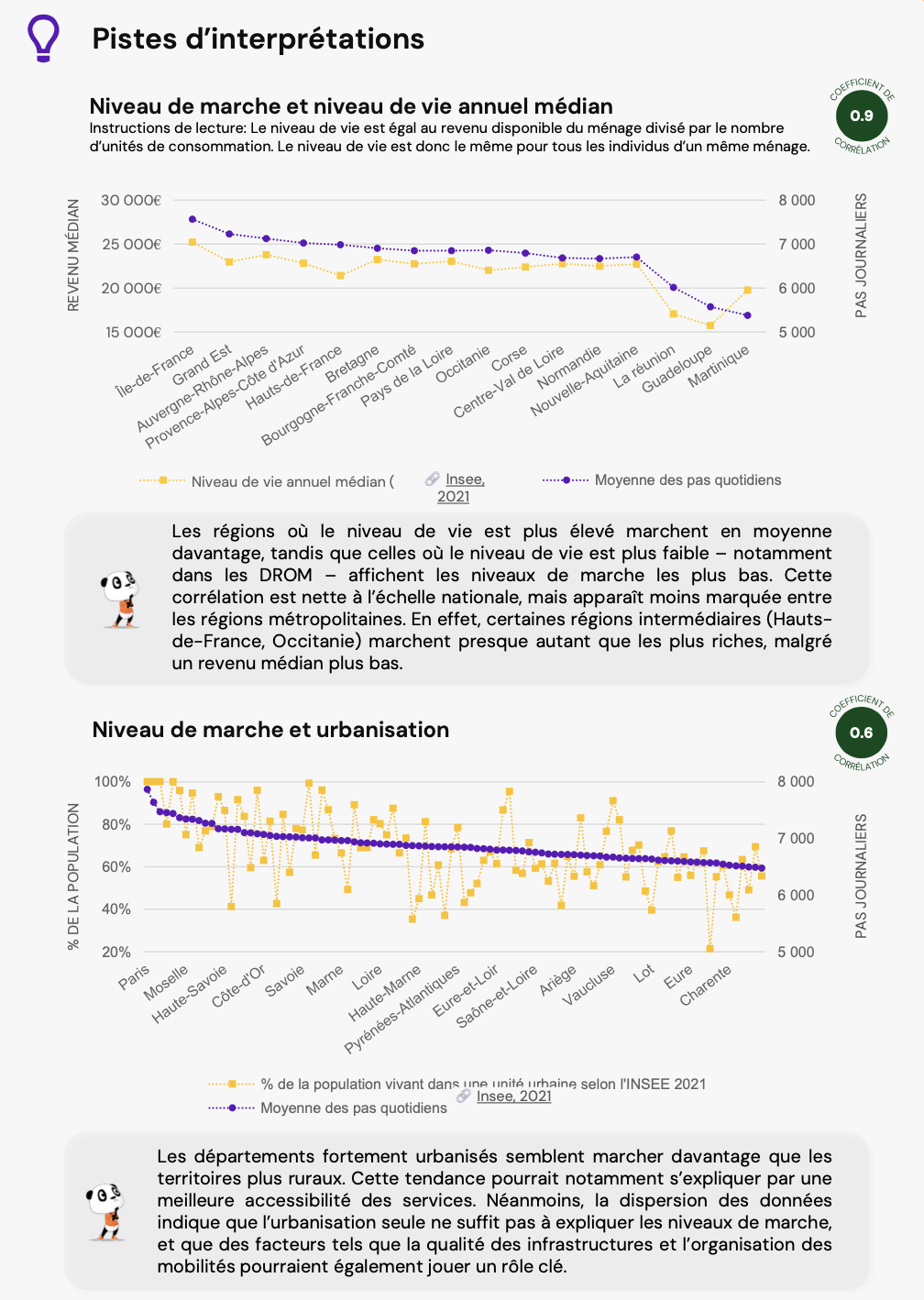
- 📊 The higher a population’s standard of living, the more likely it is to walk.
- 📊 The more urban a population is, the more it walks.
- 📊 The more cars households own, the less they walk.

🖼️ In Conclusion
Our findings confirm that physical activity is a major public health issue. It does not depend solely on individuals, but also on infrastructure, the urban environment, and everyday living conditions. It is important to highlight France’s encouraging momentum, as the French walked on average 3% more in 2025 compared to 2024. In 2026, public stakeholders will face a twofold challenge: continuing to raise awareness about the benefits of walking, and implementing urban planning and mobility policies that promote walking as an alternative to carbon-intensive modes of transportation, whenever possible.




.png)
